TL;DR Quick Answers
14x30x1 HVAC home air filter
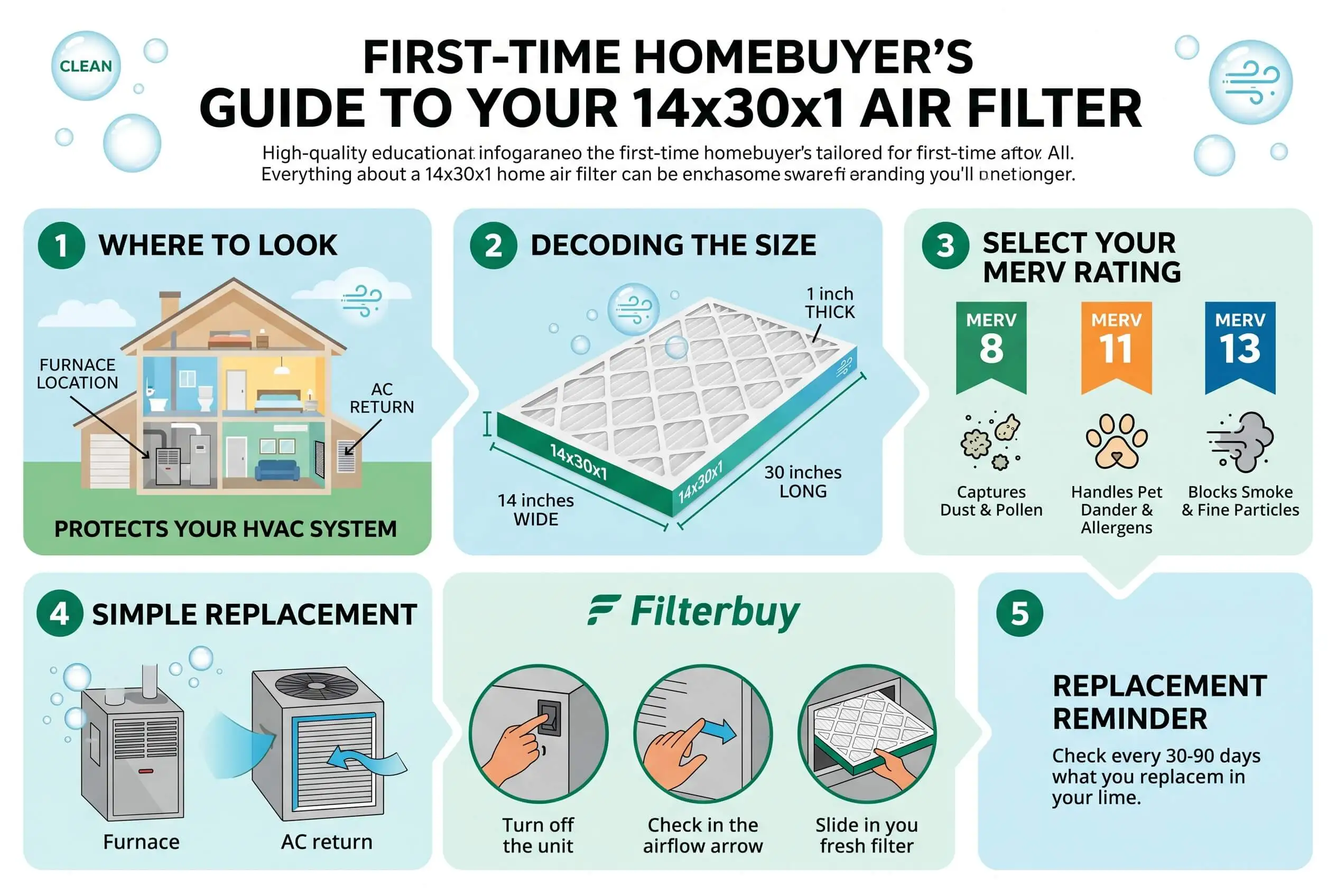
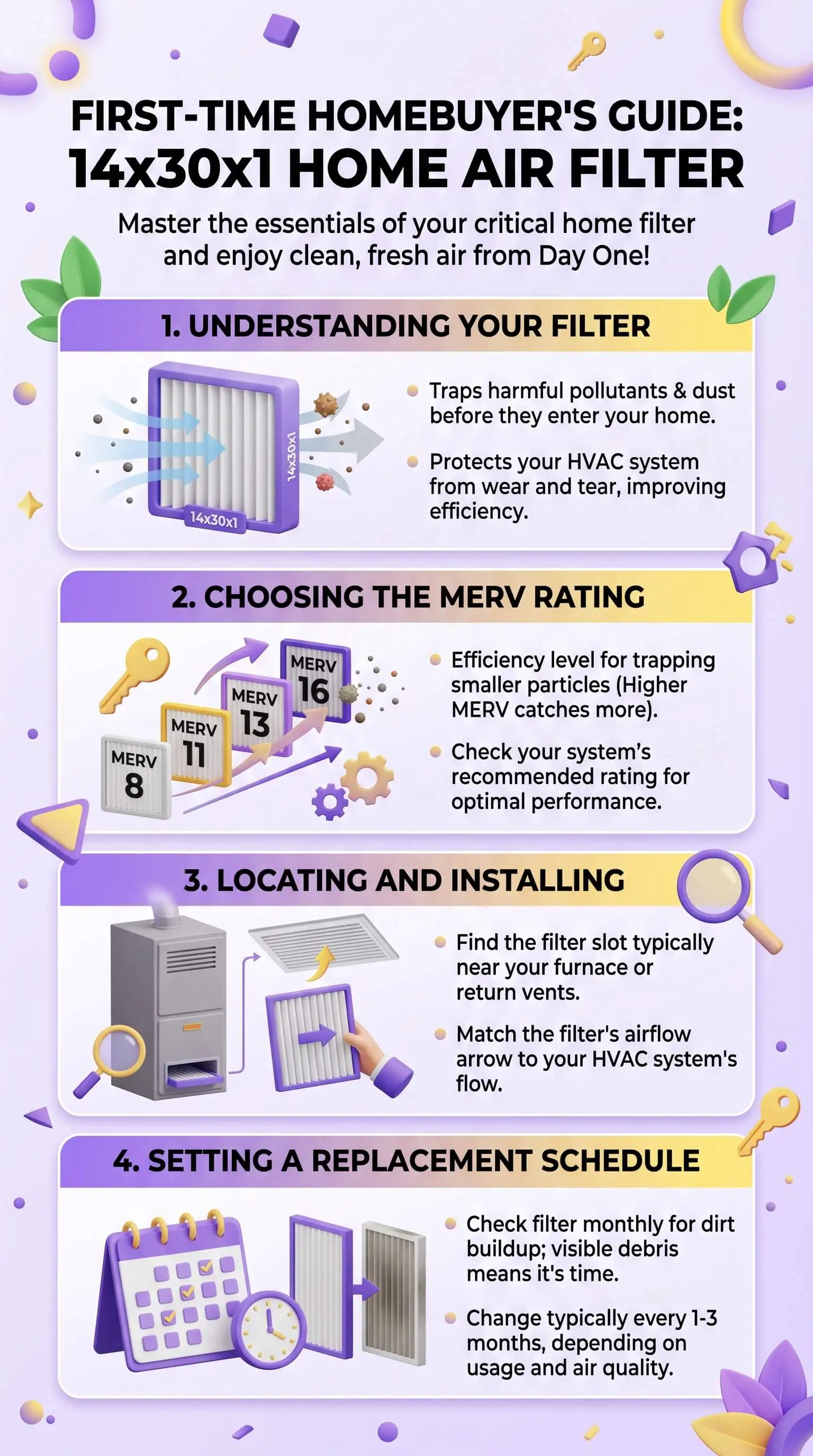
A 14x30x1 HVAC home air filter is a disposable pleated filter measuring 14 inches tall, 30 inches wide, and 1 inch deep that fits into the return grille of a central heating and cooling system. After manufacturing filters for more than a decade, we tell first-time homeowners to start with MERV 8 for a standard home, MERV 11 for pets or mild allergies, and MERV 13 only if the blower is rated for the added pressure.
Exact dimensions: 14 inches × 30 inches × 1 inch (length × width × depth).
Actual size: about 13.75 × 29.75 × 0.75 inches. The printed size is nominal, rounded to the nearest inch.
Best MERV for most first-time homeowners: MERV 8 baseline, MERV 11 with pets or allergies.
Replacement cadence: every 60 to 90 days. Cut that to 30 to 45 days with pets, smokers, or recent construction.
Installation direction: airflow arrow points toward the furnace or air handler, not toward the room.
What it protects: your blower motor, evaporator coil, utility bill, and the air your family breathes roughly 90 percent of the day.
Top Takeaways
All three dimensions matter. 14x30x1 and 14x30x2 do not swap. Confirm depth before buying.
MERV 8 or 11 is the right starting point for most first-time buyers. Skip the top-shelf ratings unless the system is rated for them.
Every 60 to 90 days is the standard cadence. Cut it in half for pets, smokers, recent construction dust, or smoke season.
Change the filter on move-in day. Do not trust that the previous owner or the seller left a clean one.
Buy a spare the first time you buy a filter. The reminder only works if a replacement is already in the closet.
The frame seal matters as much as the media. A bent corner or a gap lets unfiltered air bypass the filter.
A dirty filter costs money. Up to 15 percent of your HVAC efficiency can disappear when airflow gets restricted.
What a 14x30x1 Air Filter Actually Is
Three dimensions, in order: 14 inches tall, 30 inches wide, 1 inch deep. That last number is where new homeowners make the most expensive mistake. A 14x30x2 will not seat in a 1-inch slot, and a 14x30x1 rattles loose in a 2-inch slot, which lets unfiltered air dump straight onto your evaporator coil. The whole job of an air filter is to create a sealed barrier. A gap anywhere around the frame defeats the point.
One more thing that helps make filter replacement easier for new buyers. The printed size is the nominal size, rounded to the nearest inch. The actual filter runs about a quarter inch smaller on each edge so it slides in and out cleanly. That slight gap is by design. You still buy the 14x30x1.
Choosing the Right MERV Rating for Your First Home
MERV stands for Minimum Efficiency Reporting Value. Residential filters run from MERV 1 to MERV 16. Higher numbers catch smaller particles, which sounds like a simple 'buy the biggest number' choice, and is not. Residential blowers have limits. A filter that restricts airflow too much starves the system, runs up your utility bill, and can shorten the life of the equipment you just inherited.
Here is what we recommend for a first home, based on what we see most often:
MERV 8: the right starting point for a household with no pets, no allergies, and a standard HVAC system. Catches dust, lint, and most pollen.
MERV 11: step up for pets, mild allergies, or a household member with respiratory sensitivity. Adds fine dust and some bacteria to what it captures.
MERV 13: the ceiling for most residential systems. Catches smaller particles, including some viruses, but only if your blower can handle the extra pressure.
MERV 14 and above: built for commercial systems. A typical home blower cannot push enough air through them. Skip these.
Read your HVAC manufacturer's filter recommendation before going above MERV 11, or call a technician if the manual is missing. After manufacturing filters for more than a decade and working with over two million households, we see the same pattern over and over: a new homeowner buys the highest MERV on the shelf because it sounds safer, then wonders why the bedrooms are not cooling and the power bill climbed. Match the filter to the system, and a properly sized 14x30x1 HVAC home air filter will outwork an over-spec'd one every time.
How Often to Change a 14x30x1 Filter
Every 60 to 90 days covers most homes with a 1-inch filter. Cut that in half if any of these are true: you have indoor pets, someone smokes in the house, work just wrapped up on floors or paint, or your area runs through pollen season or wildfire smoke. Running the HVAC fan on 'always on' instead of 'auto' also loads the filter faster because air keeps moving even when the system is not heating or cooling.
Your filter is telling you to change it when you see any of these:
Gray or black cake across the intake side of the pleats.
A whistle or higher-pitched sound coming from the return grille.
Dust settling on furniture faster than it used to.
Your utility bill creeping up without a weather explanation.
What to Do on Move-In Day
A short sequence to run before you turn the HVAC on for the first time:
Pull the old filter out of the return grille. Confirm the size stamped on the frame reads 14x30x1.
Install a fresh one with the airflow arrow pointing toward the furnace or air handler, not toward the room.
Write the install date on the frame in marker so the next change is obvious.
Set a 60-day reminder on your phone. Check the filter then and decide based on what you see.
Buy a spare the same day. Most missed filter changes happen because nothing is sitting on the closet shelf when the reminder goes off.
One more thing. If the previous owner had floors refinished, cabinets replaced, or walls painted in the weeks before you closed, even top air filters work best with an earlier swap at 30 days instead of 60. Construction dust loads a fresh filter faster than anything else.
“The single most common first-home filter mistake is not picking the wrong MERV. It is forgetting the frame seal. I have watched return grilles in Alabama and Texas homes for years now, and a bent corner or a quarter-inch gap lets roughly 10 to 20 percent of your return air bypass the media entirely. That unfiltered air goes straight to the evaporator coil and builds up until a technician is standing in the garage writing an estimate. A filter that fits tight is doing real work before anyone thinks about a MERV number.”
7 Essential Resources
1. EPA Guide to Air Cleaners in the Home
Plain-language explainer from the EPA covering HVAC filters, MERV ratings, pressure drop, and how to match a filter to your system. Worth reading before the first filter purchase. Source: epa.gov/indoor-air-quality-iaq/guide-air-cleaners-home
2. EPA: What Is a MERV Rating?
A quick one-page reference on which MERV number catches which particle size. Pair it with your HVAC system manual before stepping up from MERV 8. Source: epa.gov/indoor-air-quality-iaq/what-merv-rating
3. Department of Energy: Air Conditioner Maintenance
Official maintenance guidance from the DOE on filter replacement, coil care, and the airflow issues that cut AC lifespan short. A good seasonal-rhythm starter for a first home. Source: energy.gov/energysaver/air-conditioner-maintenance
4. ENERGY STAR: Heating and Cooling Efficiency
Practical tips from the ENERGY STAR program on how filter cadence, duct sealing, and equipment age shape your monthly utility bill. First-time buyers often underestimate how much a dirty filter costs. Source: energystar.gov/saveathome/heating-cooling
5. EPA: Care for Your Air Guide to Indoor Air Quality
Broader indoor air quality primer covering what your filter is actually catching: dust, pet dander, pollen, combustion byproducts, mold spores. Context that helps you choose between MERV 8 and MERV 11. Source: epa.gov/indoor-air-quality-iaq/care-your-air-guide-indoor-air-quality
6. EPA: Asthma Triggers and How to Gain Control
If anyone in the household has asthma or year-round allergies, this resource walks through which airborne triggers a higher MERV rating helps with, and which ones need source control instead. Source: epa.gov/asthma/asthma-triggers-gain-control
7. AAFA: Control Indoor Allergens at Home
The Asthma and Allergy Foundation of America's homeowner guide on cutting dust mite, pet dander, and mold exposure at home. Filters are one layer of that strategy. This resource covers the rest. Source: aafa.org/allergies/prevent-allergies/control-indoor-allergens
Supporting Statistics
1. Americans spend roughly 90 percent of their time indoors.
The EPA reports that Americans spend about 90 percent of their time indoors, and that concentrations of some pollutants inside homes often run two to five times higher than outdoor levels. For a first-time homebuyer, choosing the right air conditioning unit and understanding the filter in your return grille can reframe that single data point. It is not a maintenance item. It is the primary barrier between your family and the air they breathe most of the day . Source: epa.gov/report-environment/indoor-air-quality
2. A well-maintained HVAC filter protects 10 to 25 percent of system efficiency.
The Department of Energy notes that the gap between a well-maintained heat pump and a neglected one can stretch from 10 to 25 percent of its energy consumption. A clogged filter is the most common cause of that gap in a residential system. Changing a 14x30x1 on schedule is one of the cheapest ways to protect both your equipment and your monthly utility bill. Source: energy.gov/energysaver/operating-and-maintaining-your-heat-pump
3. Airflow problems cut HVAC efficiency by up to 15 percent.
ENERGY STAR reports that airflow problems, most often caused by dirty filters and blocked coils, can cut a heating and cooling system's efficiency by as much as 15 percent. In plain terms: money pulled straight from your monthly budget every month the filter is overdue. Source: energystar.gov/saveathome/heating-cooling/maintenance-checklist
Final Thoughts and Opinion
Closing day reshuffles every priority. The filter in the return grille will not make the list. It should.
Two million households of experience tells us the first filter decision is simpler than it looks. Start with MERV 8 if your household runs baseline. Step up to MERV 11 if you have pets or mild allergies. Confirm your blower can handle it before reaching for MERV 13. Change the filter every 60 to 90 days, swap it at 30 days during the first three months if the home just had construction work, and buy a spare the same day you buy the first one.
What actually costs first-time homeowners money is not picking the wrong filter. It is forgetting the filter for six months, then wondering why the house feels stuffy and the utility bill jumped $40. Set the reminder today. Your future self, and the HVAC system you just paid a mortgage for, will thank you.
Frequently Asked Questions
Q: Is a 14x30x1 filter the same as a 14x30x2?
A: No. The third number is the depth. A 1-inch slot will not hold a 2-inch filter, and a 2-inch slot will not seal around a 1-inch filter. Confirm all three dimensions before buying.
The third dimension is depth, not the thickness of the packaging.
Depth controls how the filter seats in the slot.
Check the frame of your existing filter before ordering a replacement.
Q: What MERV rating should a first-time homeowner buy?
A: MERV 8 if nobody in the household has allergies and there are no pets. Move up to MERV 11 for pets or mild allergies. MERV 13 is the ceiling for most residential systems, and only if your blower is rated for the extra pressure.
MERV 8: baseline for standard homes.
MERV 11: pets, mild allergies, or one sensitive household member.
MERV 13: severe allergies or asthma, paired with a compatible blower.
Q: How often should I change a 14x30x1 filter?
A: Every 60 to 90 days in a typical home. Every 30 to 45 days if you have indoor pets, smokers, recent construction, or seasonal smoke and pollen.
Standard home: 60 to 90 days.
Pets or smokers: 30 to 45 days.
Post-construction or smoke season: check monthly.
Q: Can I wash and reuse a 14x30x1 pleated filter?
A: No. Disposable pleated filters are built for one-time use. Washing damages the media, voids the MERV rating, and can leave moisture in the pleats that grows mold.
Only filters specifically labeled 'washable' or 'reusable' can be cleaned.
Standard pleated and fiberglass filters are disposable.
A washed disposable filter usually costs more in system damage than a new one would have.
Q: What happens if I run my HVAC without a filter?
A: Dust, pet dander, and debris get pulled straight into the blower and the evaporator coil. That shortens equipment life, cuts efficiency, and leads to expensive repair calls within the first year or two of ownership.
The coil insulates with dust and loses heat-transfer capacity.
The blower motor works harder and wears out faster.
Indoor air quality drops immediately.
Q: How do I confirm the filter size in a new home?
A: Pull the existing filter out and read the dimensions stamped on the frame. If the frame is missing or the print has worn off, measure the slot opening and round to the nearest inch.
The size is usually stamped on the cardboard edge.
Length × width × depth, in that order.
When the stamp is gone, measure the slot and match the nearest standard size.
Next Steps
Pull the old filter out of the return grille today and read the size on the frame. If it says 14x30x1, you already know what to buy. Pick a MERV rating that matches your household, order two at once so the spare waits in the closet when the reminder fires, and write the install date on the frame in marker. That protects the most expensive HVAC equipment in the house, trims your monthly utility bill, and gives your family cleaner air for the next two months. Welcome home.
Better Air For All.