Smart HVAC systems do more than adjust your thermostat from your phone. They learn your household's patterns, respond to outdoor air quality conditions, and flag performance issues before they become expensive repairs. What we've found across millions of customer interactions is that homeowners who upgrade at the right time — not too early, not after the system has already failed — consistently report lower energy bills and better whole-home comfort within the first season.
This page will help you determine whether replacing your AC unit with a smart HVAC system is the right move for your home, your budget, and your family's long-term comfort.
TL;DR Quick Answers
Replacing Home AC Unit
Replacing a home AC unit costs between $4,000 and $15,000 depending on system type, home size, and installation complexity. Here is what to know before you start:
Best time to replace: Before the system fails — not during peak season when pricing is highest and options are fewest
Repair vs. replace rule: Multiply your system's age by the repair cost. If the total exceeds $5,000, replacement is the smarter long-term investment
System lifespan: Most AC units reach peak inefficiency between 10 and 15 years — even with regular maintenance
Sizing matters: A unit that is too large or too small wastes energy regardless of its efficiency rating. Always require a professional load calculation before purchasing
Installation quality is non-negotiable: Improper installation reduces a new system's efficiency by up to 30 percent before it completes a full season
Smart upgrade advantage: High-efficiency smart HVAC systems can reduce cooling energy use by up to 50 percent when correctly sized and installed
Federal tax credits available: Qualifying replacements are eligible for up to $1,200; qualifying heat pump upgrades up to $2,000
Utility rebates: Stack on top of federal credits — searchable by zip code at energystar.gov/rebate-finder
Duct inspection first: Skipping a duct evaluation before installation is the most common reason a new system underperforms from day one
Partial replacement caution: Replacing only the outdoor unit typically leads to a full replacement within two to three seasons — costing more in total
Top Takeaways
A smart HVAC upgrade is a whole-system decision, not a unit swap. Ductwork, airflow balance, filtration, and controls all determine whether a new system performs as promised. Skipping an infrastructure evaluation before upgrading the equipment is one of the most common — and costly — mistakes we see.
Improper installation is the silent budget killer. A poorly installed system loses up to 30 percent of its rated efficiency before completing a full season. A certified installer who follows manufacturer specifications isn't a premium option — it's the baseline requirement for getting what you paid for.
The best time to upgrade is before the system fails. Proactive upgrades deliver three advantages emergency replacements don't:
Better pricing outside of peak season
Time for proper load calculations and duct inspections
Full access to available tax credits and utility rebates
Federal incentives can significantly reduce your out-of-pocket cost — but only if you look for them. Key programs currently available:
Federal tax credits of up to $1,200 for qualifying AC replacements
Federal tax credits of up to $2,000 for qualifying heat pump upgrades
Additional utility rebates searchable by zip code via the EPA's ENERGY STAR Rebate Finder
Heating and cooling is your home's largest energy expense — and smart controls compound your savings. The numbers in brief:
Nearly half of the average household's annual energy bill goes to heating and cooling
ENERGY STAR certified smart thermostats deliver verified savings of more than 8 percent on those costs annually
A correctly sized, properly installed high-efficiency system compounds those savings across every season it runs
What Is a Smart HVAC System, and How Is It Different From a Standard AC?
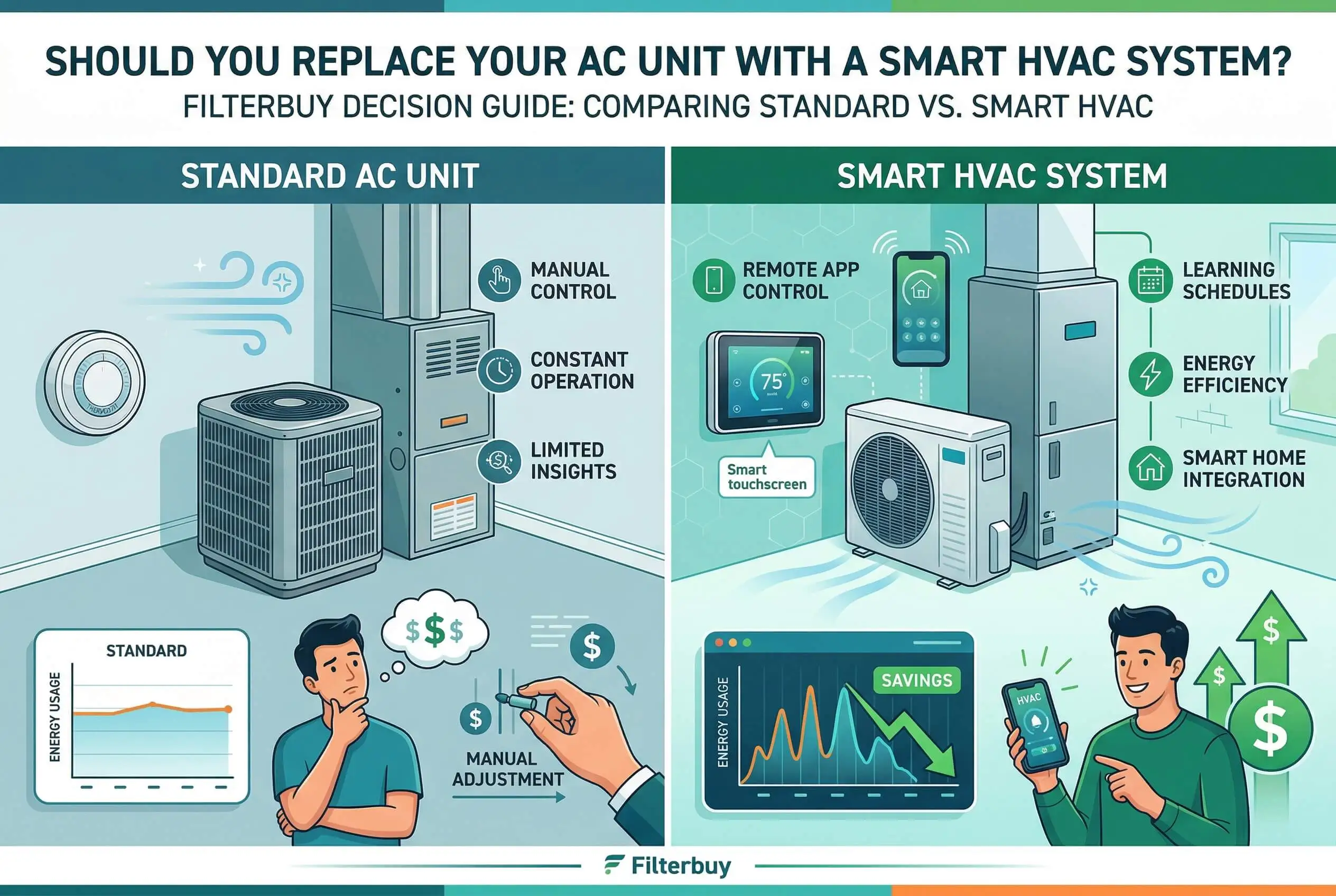
A standard AC unit does one thing: respond to the temperature reading on your thermostat. When the room gets too warm, it kicks on. When it hits the target temperature, it shuts off. That's the full extent of its awareness.
A smart HVAC system operates on an entirely different level. It learns your household's schedule, monitors indoor and outdoor conditions in real time, and adjusts its output continuously — not just when the temperature spikes. After manufacturing air filtration products for over a decade and working with millions of homeowners, we've observed that most AC inefficiencies aren't caused by a failing compressor or a refrigerant leak. They're caused by a system that has no awareness of how a home actually lives and breathes throughout the day.
Smart systems bring that awareness. Key capabilities include:
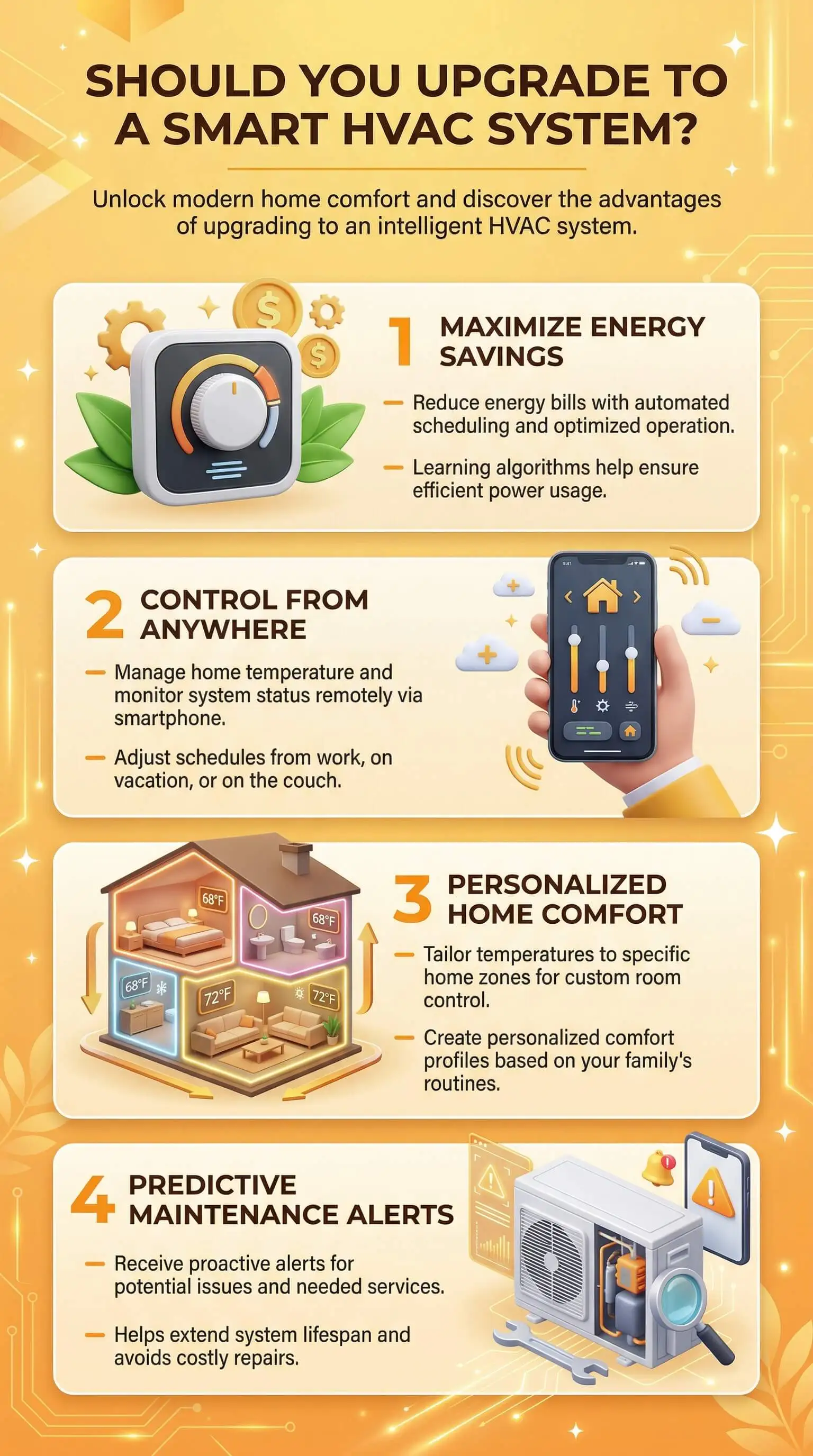
Adaptive scheduling that adjusts based on occupancy patterns, not just clock settings
Remote monitoring and control via smartphone, so comfort isn't dependent on being home
Real-time energy tracking that identifies inefficiencies before they inflate your utility bills
Indoor air quality integration that connects filtration, humidity control, and ventilation into one managed system
Predictive maintenance alerts that flag performance issues weeks before a breakdown occurs
That last point matters more than most homeowners realize. In our experience, the costliest HVAC repairs aren't sudden failures — they're gradual degradations that a connected system would have caught early.
Signs Your Current AC Unit May Be Ready for Replacement
Not every aging AC unit needs to be replaced with a smart system immediately. But certain patterns consistently point toward an upgrade being the smarter long-term investment over continued repairs.
Watch for these warning signs:
Your system is 10 to 15 years old. Most conventional AC units reach peak inefficiency around this mark, even with regular maintenance.
Your energy bills are climbing without a change in usage. A system working harder than it should is one of the clearest signals we see across customer histories.
You're dealing with uneven temperatures room to room. This almost always indicates the system is no longer capable of managing airflow across the full home.
Repair costs are approaching 50% of replacement value. At that threshold, continued repair rarely makes financial sense.
Your home still uses R-22 refrigerant. This refrigerant has been phased out under EPA regulations, making future repairs significantly more expensive and parts increasingly difficult to source.
If two or more of these apply to your home, you're likely in replacement territory — and the question shifts from whether to replace to what to replace it with.
The Real-World Benefits of Upgrading to a Smart HVAC System
The appeal of a smart HVAC system isn't novelty. It's the compounding effect of better data leading to better performance over time.
Homeowners who make the switch report three consistent improvements within the first full season of use:
Lower monthly energy costs. Smart systems eliminate the overcooling and unnecessary runtime cycles that drive up bills. The U.S. Department of Energy estimates that a programmable or smart thermostat alone can save up to 10% annually on heating and cooling costs when used correctly.
Improved whole-home comfort. Because smart systems respond to real conditions rather than a single thermostat reading, hot and cold spots throughout the home are significantly reduced.
Better indoor air quality visibility. Many smart HVAC platforms now integrate directly with air quality sensors, giving homeowners a live picture of what's circulating through their home — something a conventional AC unit can't provide.
What we've found through years of customer interactions is that homeowners tend to underestimate how much their current system's blind spots are costing them. A smart system doesn't just replace your AC — it gives you insight into your home's air that you didn't have before.
When a Smart Upgrade Makes Sense Versus When It Doesn't
A smart HVAC system is the right investment in most circumstances where replacement is already warranted. However, two scenarios can complicate the decision.
First, if your existing ductwork is significantly undersized or damaged, upgrading the system without addressing the ducts will limit the performance gains you see. A smart system can only condition and distribute air as effectively as the infrastructure allows. In our experience, skipping a duct inspection before a system upgrade is one of the most common reasons homeowners don't see the energy savings they expected.
Second, if your home is already relatively new — within the last five to seven years — and your current system is performing adequately, a smart thermostat upgrade paired with an air quality monitor may deliver 80% of the benefit at a fraction of the cost of full system replacement.
The right question isn't always "should I upgrade to a smart system?" It's "what does my home actually need to perform better?" That distinction is worth a professional assessment before committing to a full replacement.
What to Expect From the Installation Process
Smart HVAC installation varies depending on the complexity of the system selected and the condition of your existing setup. A straightforward smart thermostat installation paired with a new high-efficiency unit typically takes one to two days. A full smart system with zoning controls, air quality sensors, and integrated ventilation may require additional planning and a phased installation.
Key steps in a typical smart HVAC replacement include:
System assessment and load calculation to ensure the new unit is properly sized for your home
Duct inspection to identify any airflow restrictions before the new system is installed
Equipment installation including the air handler, condenser, and smart thermostat or control panel
System commissioning to verify that all components communicate correctly and performance meets the manufacturer's specifications
Homeowner walkthrough to ensure you understand how to use the system's smart features from day one
A properly commissioned smart system should require minimal adjustment after installation. If a technician skips the commissioning step, that's a gap worth addressing — it's the step that ensures the intelligence built into the system is actually working for your home.
"Most homeowners come to us focused on the unit itself — the brand, the SEER rating, the price tag. But after manufacturing air filtration products for over a decade and working with more than two million households, what we've learned is that the system is rarely the whole story. The ductwork, the airflow balance, the filtration — they all determine whether a smart HVAC upgrade actually delivers on its promise. A high-efficiency smart system paired with compromised ducts will still underperform. That's why we always say: before you invest in smarter equipment, make sure your home is ready to let it work. The homeowners who see the biggest gains aren't just buying better technology — they're treating the whole system as one connected environment."
Essential Resources
Replacing your AC unit is a big decision. The wrong move costs thousands. These seven resources from the U.S. government and federal energy agencies give you the facts you need — before you sign anything.
1. Understand How Your Central AC System Actually Works
U.S. Department of Energy — Central Air Conditioning https://www.energy.gov/energysaver/central-air-conditioning
Most homeowners don't know how their system works until something goes wrong. This DOE guide changes that. It covers proper sizing, SEER ratings, duct efficiency, and what a correct installation actually looks like. Read this first. It helps you ask the right questions when a contractor shows up at your door.
2. Know the Efficiency Standards Your New Unit Must Meet
U.S. Department of Energy / FEMP — Purchasing Energy-Efficient Residential Central Air Conditioners https://www.energy.gov/cmei/femp/purchasing-energy-efficient-residential-central-air-conditioners
Not every unit labeled "efficient" actually qualifies. This federal guide spells out the ENERGY STAR thresholds, SEER requirements, and refrigerant rules your replacement system must meet. If your contractor can't confirm compliance, that's a problem worth addressing before installation day.
3. Find Out If You Qualify for Up to $1,200 Back on Your Replacement
ENERGY STAR — Central Air Conditioners Tax Credit https://www.energystar.gov/about/federal-tax-credits/central-air-conditioners
A qualifying replacement unit may earn you a federal tax credit worth up to $1,200. Many homeowners miss this entirely. This ENERGY STAR page shows exactly which systems are eligible, how the 2025 SEER2 and EER2 thresholds work, and how to claim the credit on IRS Form 5695. Don't leave money on the table.
4. Replacing With a Heat Pump? You Could Qualify for Up to $2,000
ENERGY STAR — Air Source Heat Pumps Tax Credit https://www.energystar.gov/about/federal-tax-credits/air-source-heat-pumps
If you're replacing an AC-only system with a qualifying heat pump, a separate federal tax credit of up to $2,000 may apply. This page walks through the 2025 eligibility pathways — including options for both hot and cold climates. Worth a look before you decide on equipment.
5. Protect Your Investment From Day One
ENERGY STAR — Heat and Cool Efficiently https://www.energystar.gov/saveathome/heating-cooling
A new system installed incorrectly loses up to 30% of its efficiency before it ever runs a full cycle. We've seen it happen. This resource covers duct sealing, smart thermostat setup, filter maintenance schedules, and what proper installation actually requires. Your new system is only as good as the installation behind it.
6. See What Rebates Are Available Right Now in Your Area
U.S. Environmental Protection Agency — ENERGY STAR Rebate Finder https://www.energystar.gov/rebate-finder
Federal credits are only part of the savings picture. Local utility companies often offer rebates on top of them — and most homeowners never find out. Enter your zip code here. It takes two minutes and could surface hundreds of dollars in offers specific to your area.
7. Map Out Every Incentive Available for Your Upgrade
U.S. Department of Energy — Home Upgrades https://www.energy.gov/save/home-upgrades
The Inflation Reduction Act created new rebate programs that stack on top of federal tax credits for AC replacements, heat pump upgrades, and home efficiency improvements. This DOE resource lays out the full incentive landscape — including income-based options many families qualify for but don't know exist.
Supporting Statistics
After manufacturing air filtration products for over a decade and serving more than two million households, we've learned that the most expensive HVAC mistakes are rarely dramatic. They're quiet — a system running harder than it should, an installation that was never quite right, controls that never learned how the home actually lives. The numbers behind these patterns tell a consistent story.
Nearly Half of Your Home's Energy Bill Goes to Heating and Cooling
Your HVAC system — not your appliances, not your lighting — is the single largest energy expense in your home. Most homeowners we hear from don't know that until they see it in writing.
The U.S. EPA confirms that heating and cooling accounts for nearly half of total annual energy costs for the average American household
That translates to more than $900 per year — before waste is factored in
In our experience, a system that is even slightly undersized, oversized, or poorly maintained pushes that number higher without ever triggering an obvious warning sign
The bill climbs quietly, season after season
Source: U.S. Environmental Protection Agency — ENERGY STAR Smart Thermostats https://www.energystar.gov/products/smart_thermostats
A Poor Installation Can Erase 30 Percent of a New System's Efficiency Before It Ever Runs a Full Cycle
One of the most consistent patterns we observe is the gap between what a system is rated to deliver and what it actually delivers after installation.
ENERGY STAR data shows improper installation can reduce a new system's efficiency by up to 30 percent
That loss drives up utility bills and accelerates equipment wear from day one
A homeowner can invest in a high-efficiency smart HVAC system and immediately lose nearly a third of its value to a rushed or non-compliant installation
That loss rarely shows up on an invoice — it shows up on every energy bill that follows
Source: U.S. Environmental Protection Agency — ENERGY STAR, Heat and Cool Efficiently https://www.energystar.gov/saveathome/heating-cooling
Smart Thermostat Controls Deliver Verified Savings — and Compound the Value of a New System
The conversation around smart HVAC systems often focuses on the hardware. What we've found is that the controls are where the long-term efficiency gains actually live.
ENERGY STAR field data from homes across the country shows certified smart thermostats save more than 8 percent on heating and cooling costs annually
That's approximately $50 per year from the controls alone
The EPA notes savings increase based on three factors:
Local climate conditions
Household occupancy patterns
The efficiency rating of the connected system
In warmer service areas where cooling loads run longer and harder, those compounding gains arrive faster and hold longer than homeowners initially expect
Source: U.S. Environmental Protection Agency — ENERGY STAR Smart Thermostats FAQs https://www.energystar.gov/products/heating_cooling/smart_thermostats/smart_thermostat_faq
The Right Upgrade, Done Correctly, Can Cut Cooling Costs by Up to 50 Percent
The U.S. Department of Energy estimates that switching to a high-efficiency air conditioner can reduce a home's cooling energy use by up to 50 percent. That figure comes with two conditions the DOE is clear about — and two conditions we've seen skipped more than any others:
Correct sizing through a professional load calculation
Installation that meets manufacturer specifications
In our experience, these are the two steps most commonly skipped in budget-driven or emergency replacement scenarios. They're also the two steps that determine whether a homeowner sees that 50 percent potential or a fraction of it. A smart HVAC system gives you the technology. Proper sizing and installation give you the return.
Source: U.S. Department of Energy — Home Upgrades https://www.energy.gov/save/home-upgrades
Final Thoughts
Replacing your AC unit with a smart HVAC system is one of the most consequential home decisions you'll make. The stakes on either side are real.
Get it right:
Lower energy bills
Better whole-home comfort
A system that flags performance issues before they become expensive repairs
Get it wrong — wrong timing, wrong sizing, wrong installation:
A significant investment that delivers a fraction of what it promised
Efficiency losses that never show up on an invoice but appear on every energy bill that follows
After serving more than two million households and manufacturing air filtration products for over a decade, one observation has held consistently: the homeowners who come out ahead aren't necessarily the ones who spent the most or upgraded the fastest. They're the ones who treated it as a whole-system question rather than a unit-replacement transaction.
That distinction matters more than most contractors will tell you.
A smart HVAC system is not a plug-and-play upgrade. It's an interconnected environment — equipment, ductwork, airflow balance, filtration, and controls — that performs exactly as well as its weakest link allows. We've seen:
High-efficiency smart systems underperform aging conventional units because the duct system was never evaluated
Homeowners wait too long and pay emergency replacement pricing during peak season when a proactive assessment months earlier would have saved thousands
Rushed installations erase up to 30 percent of a new system's rated efficiency before the first full season is complete
Our honest opinion: the best time to evaluate a smart HVAC upgrade is before you need one.
Not when the system fails on the hottest day of the year. Not when repair estimates start approaching replacement value. The homeowners who make the smartest upgrades ask the right questions while they still have options:
What does my current system's performance data actually show?
Is my ductwork ready to support a higher-efficiency unit?
What incentives am I leaving on the table by waiting another season?
Smart HVAC technology has advanced to the point where the system can answer many of those questions on its own — but only if the foundation was built correctly from the start. Proper sizing. Compliant installation. Infrastructure that's ready to support it.
That's not a technology problem. It's a planning problem. And it's one every homeowner has the ability to solve before it becomes an emergency.
FAQ on Replacing Home AC Unit
Q: How do I know if it's time to replace my AC unit rather than repair it?
A: The clearest signal isn't a single breakdown. It's a pattern. After working with more than two million households, here is what we consistently see before a system reaches the end of its useful life:
Repair cost multiplied by system age exceeds $5,000 — you're extending a problem, not fixing one
Energy bills climb season over season with no change in usage
The system runs constantly but never reaches the set temperature
Hot and cold spots appear in rooms that used to be comfortable
Repair visits become an annual event rather than an occasional one
Our honest perspective: homeowners who wait for a complete failure almost always pay more than those who made a proactive decision six months earlier. A failing system rarely fails on a convenient day.
Q: Can I replace just the outdoor AC unit without replacing the indoor unit?
A: It's possible. We generally advise against it. Here's what most contractors won't explain upfront:
A new outdoor unit paired with an aging indoor unit creates a mismatched system
Efficiency gains get capped by the older component's limitations
Manufacturers frequently void warranty coverage on mismatched installations
Most homeowners who take the partial replacement route end up replacing the indoor unit within two to three seasons — spending more in total than a complete replacement would have cost
The one exception: your indoor unit is fewer than seven years old, confirmed compatible, and performing correctly. In that case, a targeted outdoor replacement with a verified compatibility check from a certified technician is a reasonable path.
Q: How much does it cost to replace a home AC unit with a smart HVAC system?
A: Costs vary by home size, system type, and installation complexity. Honest ranges to plan around:
Standard central AC replacement: $4,000 to $9,000 including labor
Full smart HVAC system with integrated controls and zoning: $7,500 to $15,000
Labor: approximately 30 percent of total project cost
Three cost factors most homeowners miss before purchasing:
Federal tax credits — up to $1,200 for qualifying AC replacements; up to $2,000 for qualifying heat pump systems
Utility rebates — stack on top of federal credits; searchable by zip code at energystar.gov/rebate-finder
Emergency replacement pricing — peak season installations run significantly higher than planned off-season replacements
Get three detailed quotes. Verify each includes labor, equipment, warranty terms, and any ductwork or permit requirements. The first quote is rarely the best one.
Q: Does replacing my AC unit with a smart HVAC system actually save money on energy bills?
A: Yes — but not automatically. The biggest gap we see is between homeowner expectations and real-world results. Three conditions must be in place for the savings to materialize:
Correct unit sizing through a professional load calculation — an oversized or undersized unit wastes energy regardless of its efficiency rating
Compliant installation — ENERGY STAR confirms improper installation cuts system efficiency by up to 30 percent before the first full season is complete
Smart controls that are actually configured — a smart thermostat left on default settings delivers a fraction of its potential savings
When all three are done right:
The U.S. Department of Energy estimates high-efficiency upgrades can reduce cooling energy use by up to 50 percent
ENERGY STAR certified smart thermostats add verified savings of more than 8 percent on annual heating and cooling costs
In warmer climates where cooling seasons run longer, those gains compound faster — often within the first season
Q: Do I need to replace my ductwork when I replace my AC unit?
A: Not always — but skipping the duct inspection is the single most common reason a new smart HVAC system underperforms from day one. We've seen high-efficiency systems installed into duct networks that immediately capped their output. The homeowner got a new unit. They didn't get a new performance.
Three things to evaluate before installation day:
Duct age and condition — leaks and deteriorating insulation in systems older than 15 to 20 years transfer those losses directly to the new system
Sizing compatibility — undersized ducts restrict airflow and prevent a high-efficiency unit from reaching its rated output
Sealing integrity — ENERGY STAR data shows properly sealed and insulated ducts improve system efficiency by as much as 20 percent on their own
If ducts are in good condition and correctly sized, they can support a new system without replacement. The key word is confirmed — not assumed. A duct inspection before installation isn't an add-on. It's the step that determines whether the upgrade you're investing in actually works.
Ready to Replace Your AC Unit With a Smart HVAC System?
If your current system is showing the signs, don't wait for a breakdown to make the decision for you. Contact Filterbuy HVAC Solutions today for a no-pressure assessment from your local HVAC experts — and find out exactly what a smart upgrade means for your home's comfort, efficiency, and long-term costs.
When considering Should You Replace Your AC Unit With a Smart HVAC System?, it helps to remember that smart technology still depends on proper airflow, system compatibility, and effective filtration to deliver the comfort and efficiency homeowners expect. Reviewing products like 20x20x2 MERV 8 air filter, 16x16x1 MERV 11 HVAC air filter, and 18x20x4 MERV 8 air filter can help homeowners better understand the filter sizes and filtration levels their upgraded system may need, especially if a smart HVAC replacement changes airflow requirements or overall system performance.